
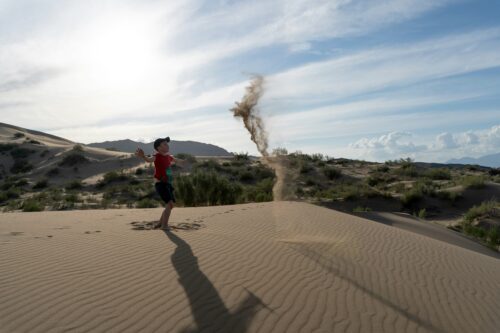
I am watching my daughter playing in the sand. She sings some unknown or imaginary song. She is alone. No other kids are at the playground near our house. I wonder if she notices, at such a young age, that she might miss the company of other people. Most of the time, she is alone with me. We are alone.
She is pouring the sand through the blue forks someone forgot in the sand. When we arrived, the sandbox was full of plastic gardening tools and toys. Kids usually leave them behind, and moms are preoccupied taking care of toddlers, often with another baby attached to them. So, they just leave the toys behind. Usually, my daughter and I forget to bring our own toys.
“Mama, look!” Sofie turns towards me, throwing sand in the air. Her thin, straight, light brown hair falls into her eyes. My mom nags that I didn’t make her wear hair accessories earlier. Now she is not used to them. She never wears ponytails or hairpins to keep her hair out of her eyes. Instead, she has gotten used to peeking through her hair, like a curtain falling from her forehead.
“Look, Mama!” she screams again.
She made a little figure in the sand with a yellow plastic mold and wants me to see it.
“Oh, a little duck, right?” I ask, barely looking in her direction. I was too into my phone.
“No! A hun.” she says.
“Oh, a hund?” I misunderstand her words.
“No, Mama. A hun.” She repeats impatiently.
She shoves the little mold into my face, where I can’t pretend to look away but actually have to.
“Ahh, kokoska,” I finally understand.
She continues talking while I am absorbed in my phone. The bench I’m sitting on is a bit uncomfortable — it’s a green metal fence with holes in it. Probably designed by men. In this atmosphere, some time passes. But not for her, more for me. Even fifteen minutes seems long to me. I just want to go home and lie comfortably on my couch.
Sofie is still in the sand, wearing her pretty new knitted pullover that we just bought. It’s in the colors of a rainbow — her favorite color combination. The sweater has little holes in it because it’s a summer pullover. Pastel colors suit her, I think to myself.
I look around. The sandbox is fenced by natural stones lying on the edges. They are big piles of rocks — flat ones, so people can sit on them. Another layer of fence is made from rounded wooden piles. Sofie is sitting in the sand, and in front of her, there is one flat rock. She is cleaning the sand from it, making a table out of it.
“Mama, look at my new Stein!” she says, turning to me.
“Ja, I see. Very nice,” I reply quietly. Why do I have to think so hard about what to say to my daughter? It should just come naturally. And it probably would if I had her in my twenties. Now, in my late thirties, beginning of forties, life just hits hard. The changes we go through at this age are obvious. We are more tired, we lack energy. Most importantly, especially after these long winters without sun, we feel lifeless. So, how can I possibly help my daughter? How can I prepare her for life when I myself don’t believe in it? And yet I must teach her so many things — the things I used to know. Now I am getting too lazy to maintain that knowledge or to follow the beliefs I used to have.
“Uuuuuuuu,” she is very excited about something. Her chanting interrupts my thoughts and brings me back to the present.
I look at her smiling, happy face.
“What is it, Sofie?”
The smile stretches all over her face. She tells me she is happy because her papa is coming home tonight. He works a lot and is on a trip — working in a city about 500 km from us. He is mostly absent for work, and she misses him. Often, in the evenings, she cries, calling for him. Sometimes the same happens when she is overwhelmed with her emotions and I am not enough. Or, actually, I am causing her distress by trying to set boundaries for her. This is the time when she turns to other comforting things that could help her — like wanting milk or calling for papa.
We are still on the playground. The clock is moving toward seven in the evening. Most of the children her age are probably already ready for bed. But with us, it is different. We don’t have a bedtime routine, although they say we should create one. But I don’t like rules — or routines. So, we are still outside, waiting for the sunset.
I listen to Sofie, who is still singing some random songs, or just talking poetically. I can’t understand it all. She speaks German at times.
She is building a downhill slope with the sand, reaching from the top of the stone to her feet. She is polishing it, trying to make it stay. But the sand is slipping downhill. It’s not really sand, more like granulated stone. It’s hard to mold. So she can’t make anything solid out of it. Soon after it is built, the shape dissolves.
“Mama, mama!” she shouts. Her eyes are wide, her mouth open. She stands up and starts to run from the sandbox toward her green roller. We parked it by a nearby tree.
“O‑o!” she screams to the wind that suddenly started to blow. It lifts her hair into the air, away from her face.
“Let’s go, Mama!” she yells. She desperately wants to leave because she’s not used to strong wind. Her overreaction comes from me. In terms of not knowing sometimes what we are doing as parents, we exaggerate often. We exaggerate because we might have seen the same reaction from other parents. We exaggerate because we think this way we are entertaining our children more. We exaggerate to get what we want, trying to fool them. After all, we exaggerate too often, too much.
“I’m coming,” I say. “Come here and put your jacket on.” I try to dress her and zip her jacket all the way up to her chin. It’s a bit cold, and I really don’t want her to catch a cold.
Now that we’ve finally made it out of the danger zone — it’s the end of March and we have made it through this year only with scarlet fever — I’m careful.
The wind starts to blow harder. I like the sound and smell of it. Spring wind always brings freshness with it. Just like the wind in the fall brings the smell of snow together with smoke from chimneys. It always reminds me of another time, when I was younger. Back then, we were always playing outside, no matter the weather. And we were never alone, like today’s kids. There were usually ten to fifteen children, most of the time.
But I remember that even as a kid, I needed at least an hour a day to be alone. Just me. I would take my dog and pretend I had to walk him. That was my time to clear my head. I’d sit on the front stairs of an old wagon we had in the yard, just looking up at the sky, letting my thoughts run freely.
I would remember people who had passed, thinking — it can’t be that bad. Some people have already done it. They died. They are released.
It’s just something I will have to do too.
And if they could do it, I can too.
That was always my final thought.
I check on Sofie. She’s become quite fast with her roller. She’s even learned how to use the brakes. Before, she used to stop with her legs — her shoes.
“Watch on your left,” I call after her. She’s still not aware that parked cars on her left can suddenly reverse.
“Ja, Mama. I’m watching,” she answers, already annoyed.
But this is just how it has to be, right? Kids get annoyed by their parents.
I’m suffocating her — just like mine did to me.
Every step, every movement accompanied by warnings and instructions. It’s too much. I have to stop that.
Sofie is so much like me — very sensitive, but also very, very stubborn.
And if I keep going like this, we’ll be fighting constantly.
I need to give her more freedom. More space to make her own decisions.
I need to learn how to guide her.